What Is a Domain Name?
A domain name is the address people enter into a web browser to visit your website. For example, in example.com, “example” is the domain name and “.com” is the domain extension, also called a top-level domain or TLD.
A good domain name should represent your website, business, organization, blog, or personal brand. It should ideally be easy to remember, spell, pronounce, and type.
Because your domain can remain associated with your website for many years, it is worth spending time choosing the right one rather than registering the first available name you find.
Start With a Clear Website Idea
Before opening Instant Domain Search, determine what your website will be about. Think about your business name, brand, industry, audience, or the type of content you plan to publish.
For example, if you are creating a technology blog, you might brainstorm words related to technology, computers, digital tools, software, or innovation. If you are starting an online store, consider words connected to your products and brand.
Creating several ideas before searching gives you more options if your first choice is already registered.
Search for Your Domain Name
Visit Instant Domain Search and enter your preferred name into the search field.
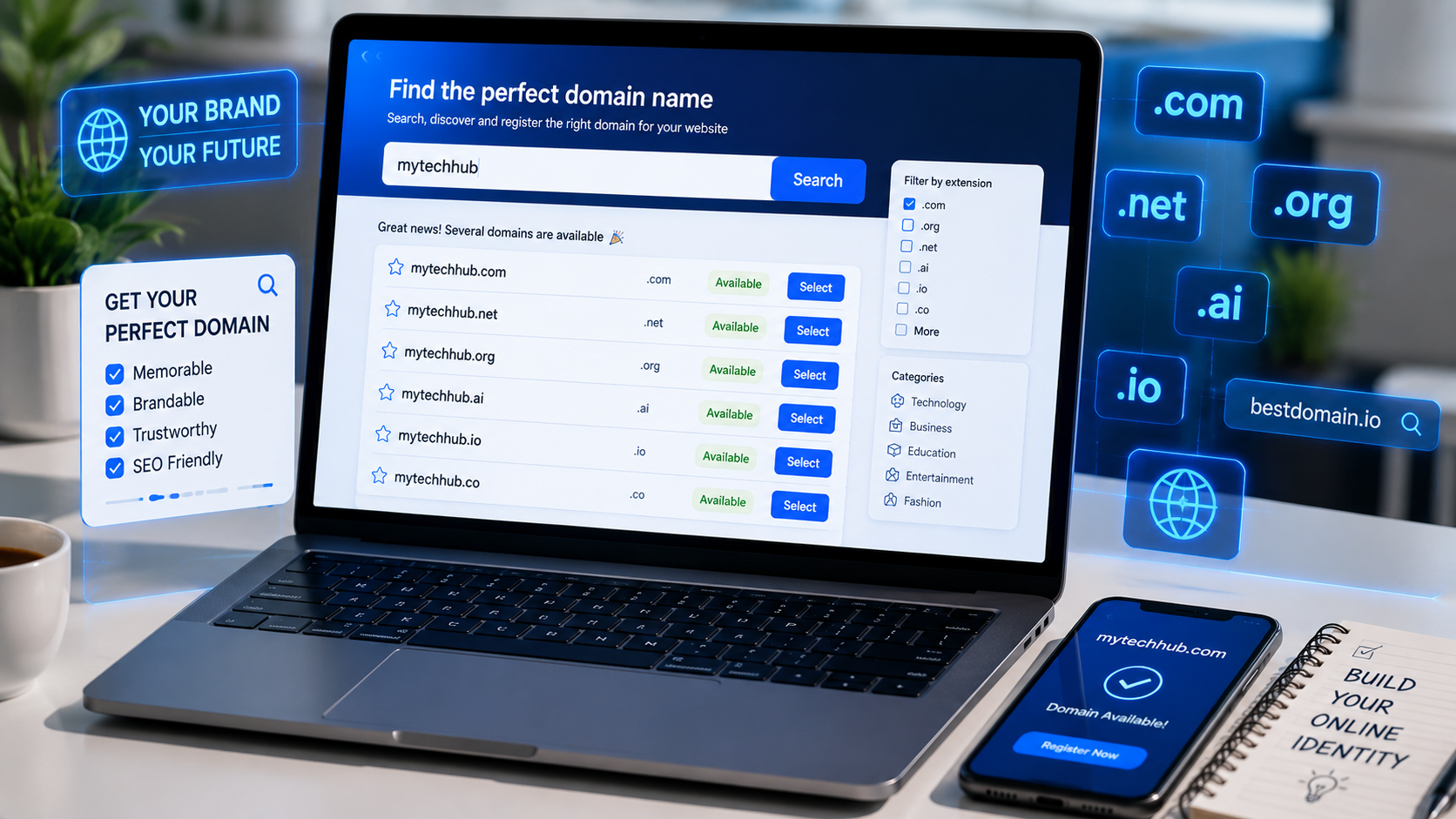
The platform checks domain availability as you type and can display results across hundreds of extensions. Available domains are distinguished from names that are already registered or listed as premium.
For example, if you want to create a website called BrightTech, you could search for variations such as:
- BrightTech.com
- BrightTech.net
- BrightTech.org
- BrightTech.ai
- BrightTech.io
You can then compare which versions are available and determine which one best suits your project.
Choose a Short and Memorable Name
A good domain name should be easy for people to remember. Avoid unnecessarily long names, complicated spelling, or combinations of words that visitors may find difficult to type.
Instant Domain Search itself recommends choosing names that are relevant, memorable, short, and on-brand.
For example, a simple name such as TechGuide.com may be easier to remember than a much longer alternative such as TheBestTechnologyGuidesOnline.com.
Short does not automatically mean better, however. Your domain should still communicate something meaningful about your website or brand.
Consider the Domain Extension
The extension is the part that comes after the name, such as .com, .org, or .net.
For many businesses and general-purpose websites, .com remains a familiar choice. However, it is not the only option. Depending on your project, extensions such as .org, .ai, .io, .app, .shop, .dev, or a country-code extension may be appropriate.
Instant Domain Search supports more than 800 extensions and displays popular and relevant options as you search.
Choose an extension based on your audience, industry, location, and branding rather than selecting one simply because it is available.
What If Your Preferred Domain Is Taken?
Do not immediately give up if your first-choice domain is unavailable. Instant Domain Search can show alternative extensions, variations, AI-generated suggestions, and aftermarket domains.
You can modify your original idea by adding a relevant word, removing an unnecessary word, or trying another extension.
For example, if BrightTech.com is unavailable, you might investigate BrightTech.org, BrightTech.ai, or another suitable alternative.
Be careful when creating variations, though. Avoid choosing a name that is confusingly similar to an established brand.
Use the Domain Generator for More Ideas
If you are struggling to create a good name, Instant Domain Search also provides an AI-powered domain name generator. It can suggest creative domain ideas based on a keyword or description.
This feature can be useful during the brainstorming stage. Instead of repeatedly guessing names manually, you can use generated suggestions as inspiration and then evaluate the options based on relevance, simplicity, availability, and branding potential.
Remember that an automatically generated name is only a starting point. You should still decide whether the name makes sense for your audience and long-term plans.
Research the Domain Before Buying
Availability alone should not determine your decision. Before registering a domain, research the name carefully.
Instant Domain Search provides research features that can include brandability information, estimated value, social handle availability, WHOIS information, and search trends.
It is also sensible to search the name on major search engines and social platforms. Check whether another company, product, or organization is already using the same or a very similar name.
This step can help you avoid future branding confusion or potential trademark problems.
Compare Registration Options
Once you find a suitable available domain, Instant Domain Search can show registration options from different registrars. The platform says its availability results can link users directly to registrars that offer the domain.
Before completing your purchase, compare the registration price, renewal price, privacy features, DNS management, customer support, and other services offered by the registrar.
Do not focus only on the first-year promotional price. Domain names are normally recurring purchases, so renewal costs matter as well.
Think Long-Term
Your domain name should be suitable for the future, not just your current project.
Avoid names that are too narrow if you expect your business or website to expand. For example, choosing a domain that specifically describes one product may become inconvenient if you later sell several different types of products.
A flexible, brandable domain can give your website room to grow.
Conclusion
Choosing a domain name does not have to be complicated. With a clear idea of your website, a list of possible names, and a reliable domain-search tool, you can make the process much easier.
Instant Domain Search allows you to check domain availability across hundreds of extensions, discover alternatives, generate name ideas, and research domains before registration.
The best domain name is not necessarily the shortest or most unusual one. It should be relevant, memorable, easy to spell, suitable for your brand, and practical for long-term use. Take your time, compare your options, research the name carefully, and choose a domain that you will be proud to build your website around.
Frequently Asked Questions
1. What is Instant Domain Search?
Instant Domain Search is an online domain-search and availability-checking tool that allows users to find domain names and explore different domain extensions. It currently supports searches across more than 800 extensions.
2. Is Instant Domain Search free?
The website provides free domain-search and availability-checking tools. Registration itself is completed through a registrar, and the price depends on the domain extension and registrar.
3. What should I look for in a domain name?
Look for a domain that is relevant, memorable, short, easy to spell, and consistent with your brand.
4. Is .com the best domain extension?
.com is a popular choice for many general-purpose websites, but other extensions can be suitable depending on your industry, audience, and location.
5. What should I do if my domain name is already taken?
Try a different extension, create a sensible variation, use the site’s domain generator, or investigate whether the existing domain is available through an aftermarket marketplace.
6. Should I buy a premium domain?
Not necessarily. A premium domain may be valuable, but you should consider its price, relevance, branding potential, and whether it provides enough value for your particular project.
7. Can I check multiple domain names at once?
Yes. Instant Domain Search provides a bulk domain-search feature that can check large lists of domain names at once.