12V vs 24V Inverter: Key Differences, Pros & Cons
When choosing an inverter system, one of the most important decisions is selecting the correct DC system voltage. Two common options are 12V and 24V.
At first glance, the difference may appear simple. One inverter works with a 12-volt battery system while the other works with a 24-volt battery system. However, the voltage you choose can affect current requirements, cable size, battery configuration, efficiency, system expansion, and overall installation cost.
Understanding these differences is important before purchasing an inverter, especially if you are building a backup power system, solar installation, or battery-powered electrical setup.
What Is an Inverter?
An inverter is an electronic device that converts direct current (DC) electricity from a battery or other DC source into alternating current (AC) electricity.
Batteries normally store energy as DC power, while many household appliances are designed to operate using AC electricity.
An inverter acts as the bridge between these systems.
For example, a battery bank can provide DC power to an inverter, which then produces AC electricity for compatible appliances.
Inverters are available in different voltage and power ratings.
What Does 12V Mean?
A 12V inverter is designed to operate with a nominal 12-volt battery system.
A typical 12V system may use one 12V battery, although the actual battery voltage changes depending on its state of charge and chemistry.
A 12V system is commonly used for:
- Small backup systems.
- Cars and vehicles.
- Small solar installations.
- Camping systems.
- Small appliances.
- Portable power applications.
The major advantage of 12V is simplicity.
If your application requires relatively low power, a 12V system can be convenient and easy to understand.
What Does 24V Mean?
A 24V inverter is designed for a nominal 24-volt battery system.
A 24V battery bank can be built using batteries configured appropriately in series or by using a battery designed for 24V operation.
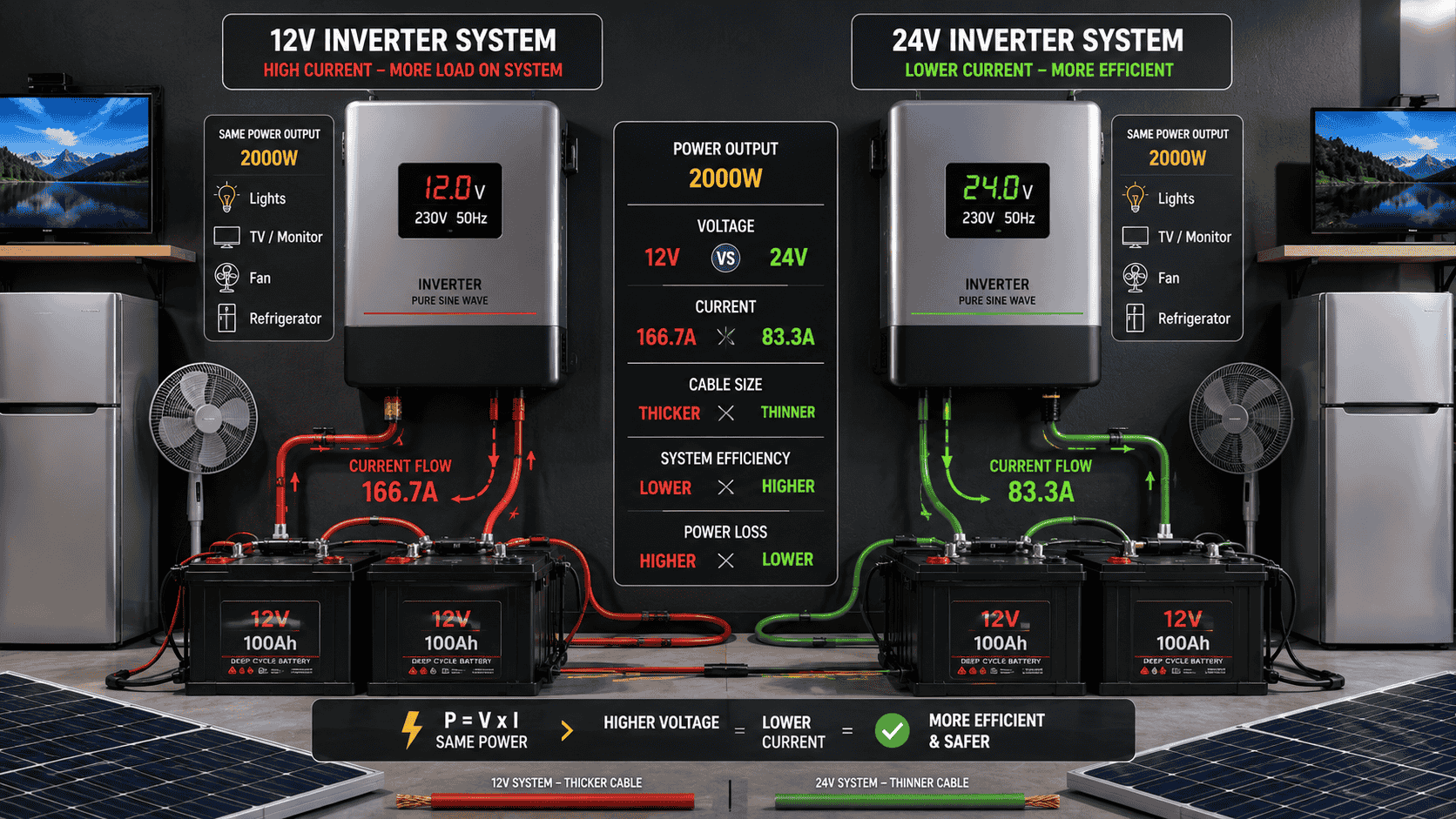
24V systems are often more attractive for larger installations because they can deliver the same amount of power at lower current compared with a 12V system.
This can reduce the current flowing through cables and other components.
Current Is the Major Difference
The relationship between power, voltage, and current can be represented by:
Power = Voltage × Current
Therefore:
Current = Power ÷ Voltage
Suppose an inverter needs to deliver approximately 1,200 watts.
At 12V:
1,200 ÷ 12 = 100 amps
At 24V:
1,200 ÷ 24 = 50 amps
This simplified example demonstrates why higher-voltage battery systems are attractive for larger loads.
The 24V system requires approximately half the current for the same power.
In real installations, inverter efficiency and voltage variation mean actual current will differ, but the principle remains important.
Cable Size
Higher current requires appropriate cables and connections.
A 12V system delivering significant power can require very thick cables because the battery-side current can become extremely high.
A 24V system delivering the same power can reduce the required current.
This may allow the use of more manageable cable sizes, depending on the installation requirements.
However, cable size should never be selected based only on voltage. Cable length, allowable voltage drop, insulation, temperature, installation method, current capacity, and local electrical requirements must also be considered.
Efficiency
A 24V system can offer practical efficiency advantages in higher-power applications because lower current can reduce resistive losses in cables and connections.
Power lost as heat in a conductor is related to current squared:
P = I²R
This means reducing current can significantly reduce resistive losses when cable resistance remains the same.
This is one reason higher-voltage battery systems are often preferred for larger installations.
However, the inverter itself also has conversion losses, so overall system efficiency depends on the inverter, batteries, cables, connections, load, and operating conditions.
Battery Configuration
The battery configuration is another major difference.
A 12V system can use a suitable 12V battery.
A 24V system may use two compatible 12V batteries connected in series to create a nominal 24V battery bank.
When batteries are connected in series, the voltages add while the amp-hour capacity remains based on the individual battery rating.
For example, two compatible 12V 100Ah batteries connected in series form a nominal 24V 100Ah bank.
This is not the same as 24V 200Ah.
Battery chemistry, manufacturer instructions, balancing requirements, and battery-management systems must be considered before connecting batteries.
12V vs 24V for Solar Systems
For small solar systems, 12V can be perfectly adequate.
For larger solar and backup installations, 24V may be more practical.
Consider a system that needs to power multiple appliances simultaneously. The higher the total load, the greater the DC current required at a lower voltage.
Moving from 12V to 24V can reduce battery-side current for the same power.
For even larger installations, systems using 48V or other higher DC voltages may be considered.
Which Is Better: 12V or 24V?
Neither voltage is universally better.
The right option depends on the size and purpose of your system.
Choose 12V when:
- The power requirement is relatively small.
- You need a simple system.
- You are powering vehicle equipment.
- You already have a suitable 12V battery.
- Cable runs are short.
- Portability is important.
Choose 24V when:
- Your power requirement is higher.
- You want lower DC current.
- You want to reduce cable current.
- You are building a larger backup system.
- You expect to expand the system.
- Your inverter and batteries support 24V operation.
Can a 12V Inverter Work With 24V Batteries?
No. You should not connect a 12V inverter directly to a 24V battery bank unless the inverter is specifically designed to accept that voltage range.
Doing so can damage the inverter and create a serious electrical hazard.
Likewise, a 24V inverter should not be connected to a 12V battery system and expected to operate normally.
Always match:
Battery system voltage → Inverter input voltage
Before connecting equipment, check the manufacturer’s specifications.
Which Is Better for a Home Backup System?
For a small home backup installation, 12V may work for limited loads.
However, as power requirements increase, 24V can become more practical because of the lower current.
For example, powering lights, routers, televisions, and small electronics may be manageable with a smaller 12V system.
Running larger loads such as refrigerators, pumps, multiple appliances, or higher-power equipment may make a higher-voltage battery system more attractive.
The exact choice should be based on the total load, expected runtime, battery capacity, inverter efficiency, solar input, cable distances, and future expansion plans.
Safety Considerations
Battery and inverter systems can produce dangerous currents even at relatively low voltages.
A short circuit on a battery bank can release extremely high current and generate heat, sparks, or fire.
Always use appropriately rated:
- Fuses.
- Breakers.
- Cables.
- Connectors.
- Battery-management equipment.
- Isolation devices.
Do not connect batteries in series or parallel unless they are compatible and the manufacturer permits the configuration.
For larger installations, professional electrical assistance is strongly recommended.
Final Thoughts
The main difference between a 12V and 24V inverter is the DC voltage required by the battery system.
A 12V system is often convenient for smaller applications, while a 24V system can be more suitable for higher-power installations because the same power requires less current.
For example, a simplified 1,200W load would require approximately 100A at 12V but approximately 50A at 24V before accounting for inverter losses and voltage variations.
The right choice depends on the size, purpose, battery configuration, cable requirements, and future expansion of your system.
Most importantly, never connect an inverter to a battery bank with the wrong voltage. Always check the inverter and battery manufacturer’s specifications and use properly rated electrical protection.
KEYNOTES
1. Is a 24V inverter better than a 12V inverter?
Not always. A 24V system is generally more attractive for higher-power applications, while 12V can be convenient for smaller systems.
2. Does 24V use less electricity than 12V?
For the same power output, a 24V system requires less current, which can reduce cable losses. It does not magically make the appliance itself consume less energy.
3. Can I connect a 12V inverter to 24V batteries?
No. The inverter’s input voltage must be compatible with the battery system.
4. Can two 12V batteries make 24V?
Two compatible 12V batteries can be connected in series to create a nominal 24V battery bank, provided the manufacturers permit the configuration.
5. Which is better for solar: 12V or 24V?
12V can work well for smaller systems, while 24V is often more practical as system power requirements increase.
6. Why does 24V require smaller cables for the same power?
Because higher voltage means lower current for the same power, although cable selection must still follow electrical and installation requirements.
Looking for more helpful information? Check out the highlighted links throughout this article for detailed guides, or explore our blog for additional tutorials, expert tips, and useful resources. At AskMyQuestions.com, we provide practical, easy-to-follow content designed to help you learn more, solve common problems, and stay informed.
Visit AskMyQuestions.com and explore more today!